

Colt's · Revolver
Colt Model 1860 Army Revolver
.44 Caliber Percussion · introduced 1860
Also known as Colt 1860 Army, Colt New Model Army, Colt .44 Army
About the Colt Model 1860 Army Revolver
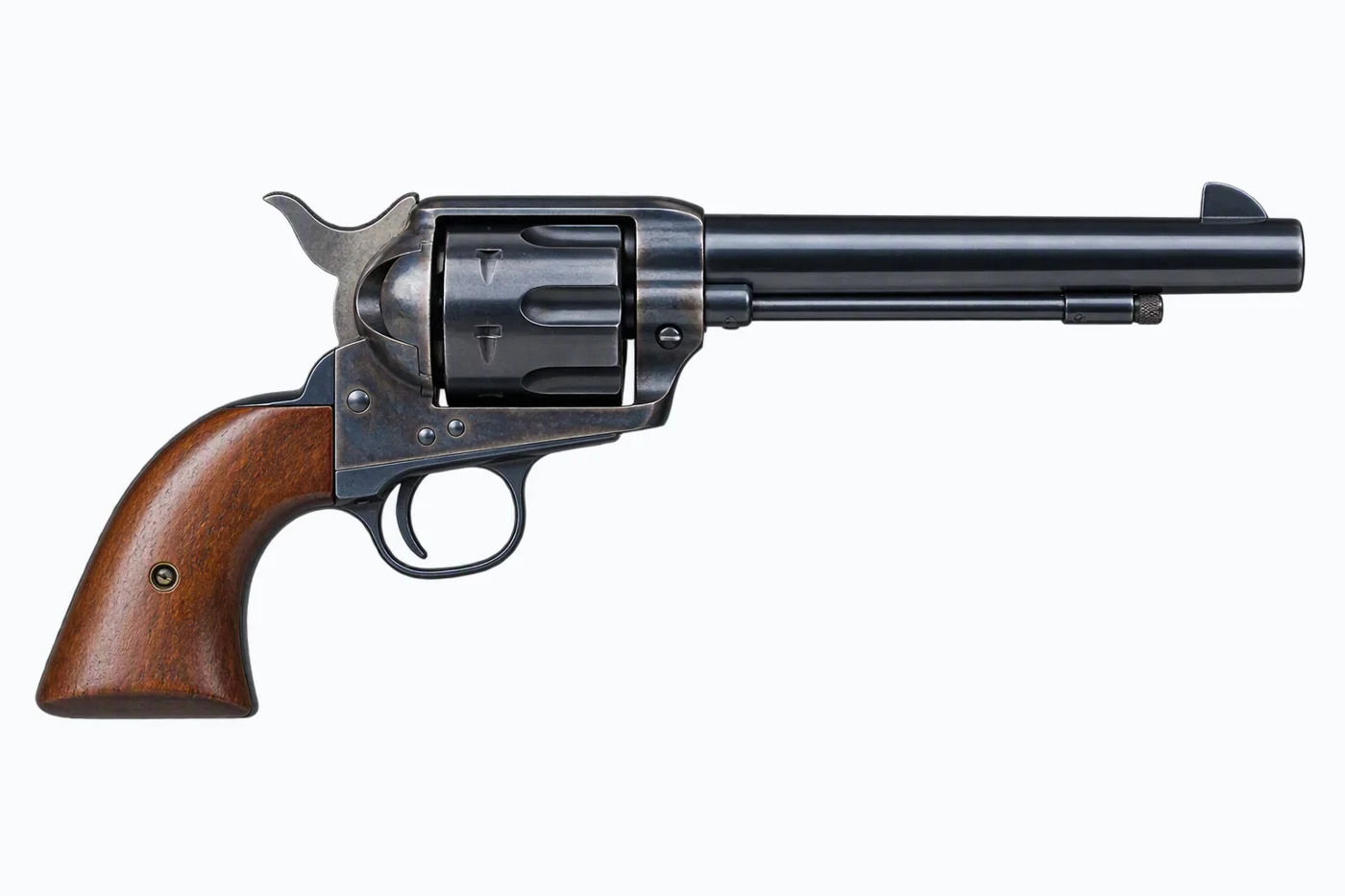
The Colt Model 1860 Army Revolver is a six-shot, single-action percussion cap-and-ball revolver designed by Samuel Colt and produced at the Colt's Patent Fire-Arms Manufacturing Company in Hartford, Connecticut between 1860 and 1873. It was the principal revolver of the Union Army during the American Civil War, with approximately 130,000 delivered on U.S. government contracts out of an estimated 200,000 total production. Chambered for a nominal .44 caliber round ball - or a conical "picket" bullet - seated over a charge of loose black powder with percussion caps providing ignition, the revolver loads individually at the front of each chamber via a "creeping" rack-and-pinion loading lever of improved design beneath the barrel. Mechanically and stylistically the 1860 Army was Samuel Colt's evolutionary refinement of his 1851 Navy: it kept the Navy's open-top frame and graceful handling, but enlarged the chambering to .44 caliber through the use of a rebated, "stepped" cylinder, and streamlined the barrel with a round tapered profile in place of the Navy's octagonal barrel. The result was a revolver that delivered Dragoon-class firepower in a package scarcely heavier than the slim .36 Navy, weighing roughly 1,190 grams with a 203 mm (8-inch) barrel and an overall length of approximately 356 mm. The frame and loading lever are forged steel with color case-hardened finish, the barrel and cylinder are blued, the trigger guard is brass, and the backstrap is silver-plated brass on civilian guns or iron on military contract guns. Standard early cylinders were roll-engraved with the same Texas Navy battle scene used on the 1851 Navy, while early production featured a fluted cylinder (quickly superseded by the standard round rebated cylinder). Four-screw military contract frames were cut to accept a detachable shoulder stock for carbine-like use by cavalry. Operation is strictly single-action: the hammer must be manually thumb-cocked for each shot, which rotates the cylinder and indexes a fresh chamber; safety notches between chambers permit the hammer to rest safely between loaded chambers. Samuel Colt personally oversaw the design and early production of the 1860 Army but died in January 1862 at the age of 47, making this revolver the last he personally shepherded to market. Production continued at Hartford under his successors until 1873, when the metallic-cartridge era and Colt's own Single Action Army rendered percussion revolvers obsolete. In the post-war years thousands of surviving 1860 Armies were factory-converted for metallic cartridges as the Richards Conversion (1871) and Richards-Mason Conversion, and substantial numbers were exported to Europe - notably to France during the Franco-Prussian War.
The 1860 Army was the final revolver design Samuel Colt personally oversaw - he died of gout at age 47 in January 1862, barely a year after the revolver entered mass production, with his Hartford armory running at full wartime capacity to arm the Union. The trick that defined the gun was the rebated "stepped" cylinder, which let Colt squeeze a .44-caliber chamber into a frame scarcely heavier than the slim .36 Navy - essentially a Dragoon's bite in a Navy's hand. After Appomattox, Colt's percussion business collapsed against the rise of metallic cartridges, and it was the Richards and Richards-Mason conversions of leftover 1860 Army frames - not any new design - that kept Colt in the revolver business long enough to reach the 1873 Single Action Army.
Colt Model 1860 Army Revolver specifications
General
- Type
- Revolver
- Firing mechanism
- Single action
- Trigger
- Single action
- Calibres
- .44 Caliber Percussion
- Magazine capacity
- 6 rounds
- Magazine
- Revolving cylinder
Dimensions
- Barrel length
- 203 mm (8.0 in)
- Overall length
- 356 mm (14.0 in)
- Height
- 140 mm (5.5 in)
- Width
- 45 mm (1.8 in)
- Weight (empty)
- 1.19 kg (2.62 lb)
Barrel
- Rifling
- Right hand
- Grooves
- 7
Materials
- Barrel
- Steel
- Receiver / frame
- Steel
- Stock
- Walnut
- Finish
- blued_with_color_case_hardened_frame
Performance
- Muzzle velocity (typical)
- 275 m/s (902 fps)
- Muzzle energy (typical)
- 360 J (266 ft·lb)
- Effective range
- 45 m
History
- Introduced
- 1860
- Discontinued
- 1873
- Production status
- Out of production
- Country of origin
- US
- Designer
- Samuel Colt
Features
- Streamlined round tapered barrel
- Creeping loading lever
- Rebated cylinder
- Roll engraved naval battle scene cylinder
- Color case hardened frame
- Brass trigger guard
- Silver plated brass backstrap civilian
- Iron backstrap military contract
- Fixed v notch rear sight
- Brass cone front sight
- Open top frame
- Percussion cap nipples
- Shoulder stock cut four screw frame
Safety
- Hammer safety notches between chambers
The 1860 Army's rebated "stepped" cylinder is the feature that allowed Colt to fit a .44-caliber chamber into a frame scarcely larger than the .36-caliber 1851 Navy's - the rear of the cylinder is the same diameter as the Navy's, while the front steps out to accommodate the larger bore. Early fluted cylinders (the first 4,000 or so guns) were abandoned after reports of cylinders bursting along the flutes; the standard round rebated cylinder that followed was noticeably stronger. Four-screw frames are the scarcer and more collectible military variant, identifiable by the shoulder-stock cutouts on the recoil shield and frame. Confederate forces could not match the 1860's quality and instead produced brass-framed copies of the older .36 Navy (Griswold & Gunnison, Leech & Rigdon), so captured Union 1860 Armies were highly prized in the South.
Similar models
Bentley Transitional Revolver
Revolving · .44 Caliber Percussion

Colt .38 Super Model O
Short recoil (semi-automatic) · .38 Super

Colt .380 Government
Short recoil (semi-automatic) · .380 ACP

Colt .380 Mustang Pocketlite
Short recoil (semi-automatic) · .380 ACP
Colt .380 Mustang XSP
Short recoil (semi-automatic) · .380 ACP

Colt 1860 Army
Revolving · .44 Caliber Percussion
Colt 1878 Frontier
Revolving · .45 Colt
Colt 1903
Short recoil (semi-automatic) · .32 ACP