

Colt's · Revolver
Colt Dragoon Model 1848
.44 Caliber Round Ball (Dragoon load) · introduced 1848
Also known as Colt Dragoon, Dragoon Revolver, Model 1848 Dragoon
About the Colt Dragoon Model 1848
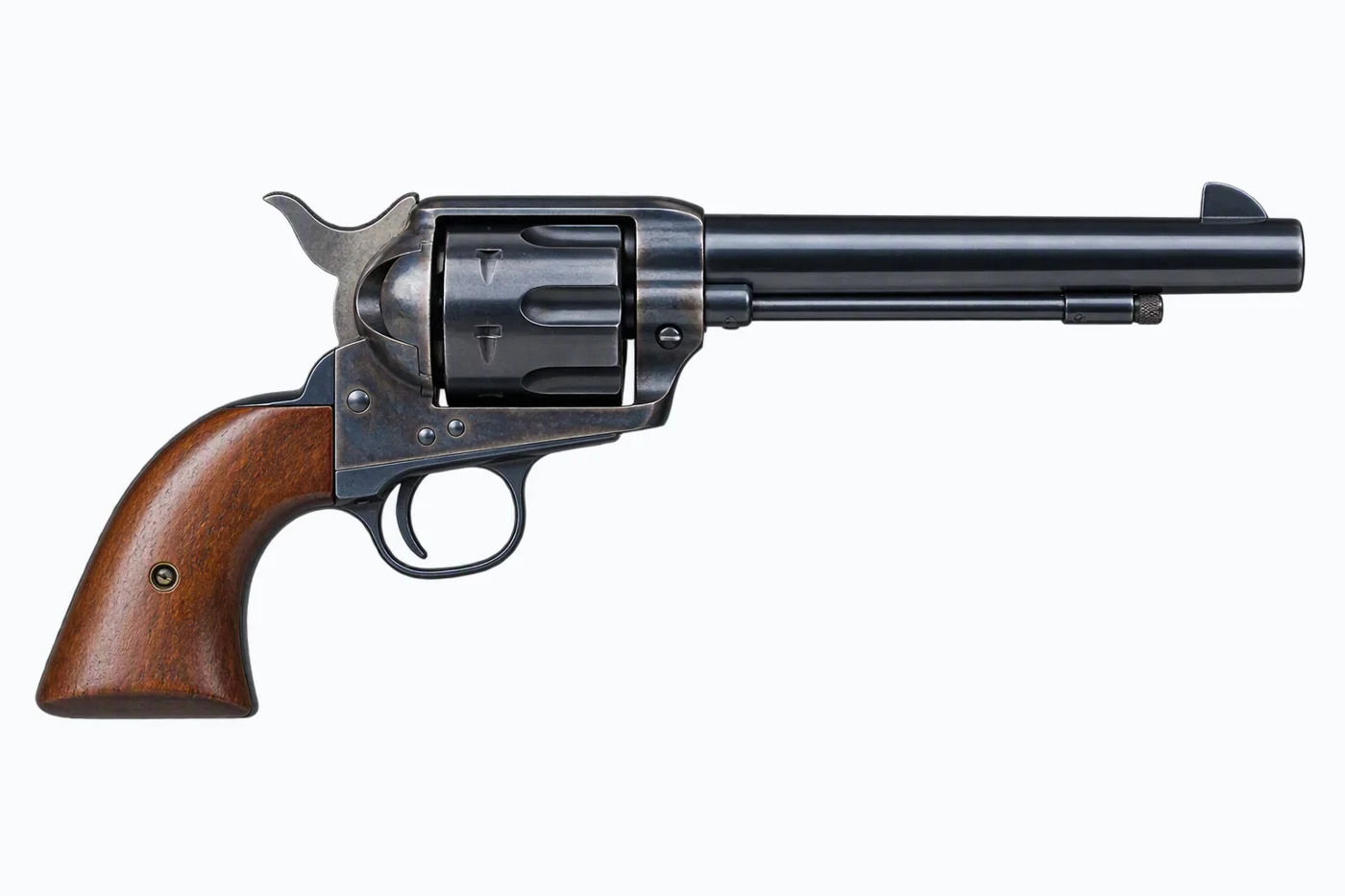
The Colt Dragoon Model 1848 is a single-action, six-shot .44 caliber percussion revolver designed by Samuel Colt as the direct successor to the catastrophic-but-powerful Colt Walker Model 1847. Produced in three successive models (First Model 1848-1850, Second Model 1850-1851, and Third Model 1851-1860) at Colt's new Hartford, Connecticut factory, the Dragoon addressed every major combat complaint raised by the United States Mounted Rifles and Dragoon regiments about the Walker: the cylinder was shortened from 2.5 inches to roughly 2.19 inches to reduce the chamber volume and eliminate chamber burst failures, the powder charge was reduced from 60 grains to approximately 50 grains of black powder, the loading lever was redesigned with a positive-locking latch so it no longer dropped under recoil and jammed the cylinder, and overall weight was reduced from the Walker's 4.5 pounds (2,041 g) to approximately 4 pounds (1,800 g). The Dragoon retains a 7.5-inch (191 mm) part-octagon part-round barrel, an open-top steel frame, a seven-groove left-hand-twist rifled bore, a one-piece walnut grip, and the roll-engraved cylinder depicting the Battle of Bandera Pass between Texas Rangers and Comanche warriors. Like the Walker before it, the Dragoon was issued in pairs carried in large leather saddle-mounted pommel holsters - giving a single mounted trooper twelve .44 caliber shots available without reloading - and it remained the standard United States cavalry sidearm until it was progressively replaced by the lighter Colt 1851 Navy and Colt 1860 Army revolvers in the late 1850s and early 1860s. Approximately 20,000 Dragoons were produced across all three models between 1848 and 1860, and although considered obsolescent by the outbreak of the American Civil War in 1861, large numbers of surviving Dragoons were issued to Union and Confederate cavalry troopers - particularly in the Trans-Mississippi and western theaters - and the design remained in civilian frontier use throughout the settlement of the American West.
Samuel Colt built the Dragoon by listening to his customers: after the Walker earned a fearsome reputation in the Mexican-American War but also a long list of battlefield complaints - burst cylinders, snapped loading levers, and the sheer back-breaking weight of a 4.5-pound revolver - Colt used the profits from the Walker contract to open his Hartford factory and immediately produced a refined version that corrected every one of those failures while losing almost none of the stopping power. A United States Dragoon trooper of 1850 rode with a pair of these revolvers slung in pommel holsters on either side of his saddle, giving his horse effectively twelve .44 caliber shots before the man even had to reach for powder and ball - a volume of rapid mounted firepower unmatched by any other army in the world at that moment. The gun was so durable and so respected that it remained in front-line use for more than a decade, and when the Civil War broke out in 1861 it was still considered serviceable enough that veteran Confederate cavalrymen fought the first battles of the war with Dragoons their fathers had carried across the plains.
Colt Dragoon Model 1848 specifications
General
- Type
- Revolver
- Firing mechanism
- Single action
- Trigger
- Single action
- Calibres
- .44 Caliber Round Ball (Dragoon load)
- Magazine capacity
- 6 rounds
- Magazine
- Revolving cylinder
Dimensions
- Barrel length
- 191 mm (7.5 in)
- Overall length
- 362 mm (14.3 in)
- Weight (empty)
- 1.80 kg (3.97 lb)
Barrel
- Rifling
- Left hand
- Grooves
- 7
Materials
- Barrel
- Steel
- Receiver / frame
- Steel
- Stock
- Walnut
- Finish
- blued_case_hardened
Performance
- Muzzle velocity (typical)
- 290 m/s (951 fps)
- Muzzle energy (typical)
- 409 J (302 ft·lb)
- Effective range
- 68 m
History
- Introduced
- 1848
- Discontinued
- 1860
- Production status
- Out of production
- Country of origin
- US
- Designer
- Samuel Colt
Features
- Percussion cap ignition
- Six shot cylinder
- Open top frame
- Part octagon part round barrel
- Improved latching loading lever
- Roll engraved cylinder ranger indian fight scene
- Brass trigger guard
- One piece walnut grip
- Shortened cylinder from walker
- Reduced powder charge from walker
Safety
- Hammer rest pins between chambers
Loading procedure is identical to the Walker: pour a measured charge of approximately 50 grains of FFFg black powder into each chamber, seat a lubricated .454 round ball (or conical bullet) over the powder with the rammer-type loading lever, apply bore grease over the seated ball to prevent chain-fires, and cap each nipple at the rear of the cylinder with a #11 percussion cap. Safe carry is traditionally with the hammer rested on a pin between two chambers or on an empty chamber. The three models are most quickly distinguished by cylinder-stop shape (oval on 1st Model, rectangular on 2nd and 3rd Models), trigger guard shape (square-back on 1st and 2nd, rounded on 3rd), and mainspring/hammer details. Third Model Dragoons were available with optional folding-leaf rear sights and shoulder-stock attachment cuts on the grip frame, allowing conversion to a rudimentary carbine configuration.
Similar models
Bentley Transitional Revolver
Revolving · .44 Caliber Percussion

Colt .38 Super Model O
Short recoil (semi-automatic) · .38 Super

Colt .380 Government
Short recoil (semi-automatic) · .380 ACP

Colt .380 Mustang Pocketlite
Short recoil (semi-automatic) · .380 ACP
Colt .380 Mustang XSP
Short recoil (semi-automatic) · .380 ACP

Colt 1860 Army
Revolving · .44 Caliber Percussion
Colt 1878 Frontier
Revolving · .45 Colt
Colt 1903
Short recoil (semi-automatic) · .32 ACP