Royal · Sniper Rifle
Boys Anti-Tank Rifle
Bolt action · .55 Boys · introduced 1937
Also known as Boys Rifle, Elephant Gun, Stanchion
About the Boys Anti-Tank Rifle
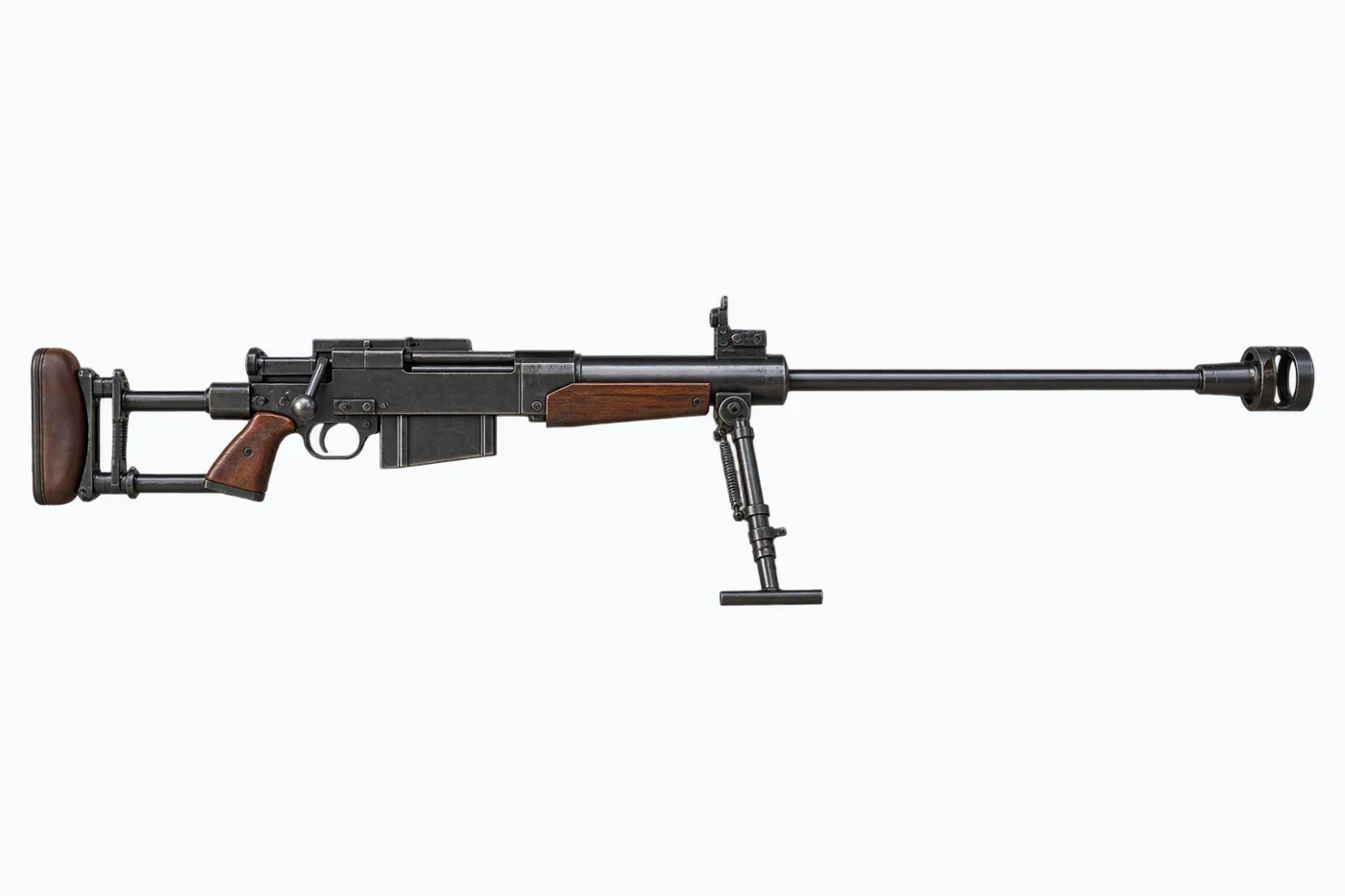
The Boys Anti-Tank Rifle is a British bolt-action anti-tank weapon chambered in the proprietary .55 Boys (13.9x99mmB) belted cartridge, designed at the Royal Small Arms Factory, Enfield, and adopted by the British Army in 1937. Named after Captain Henry C. Boys, the weapon's chief designer who died shortly before its adoption, it featured a distinctive T-shaped bipod, a circular muzzle brake, and a heavily padded buttstock with recoil-absorbing mechanism to manage the punishing recoil. At 16.3 kg, it was one of the lighter anti-tank rifles of the era, though troops universally dreaded its brutal recoil and nicknamed it the 'elephant gun.'
The Boys Anti-Tank Rifle earned the unflattering nickname 'Charlie the Bastard' among British troops due to its vicious recoil that frequently left shooters with severe bruising. During the Battle of France in 1940, British soldiers discovered to their dismay that the weapon was already inadequate against the frontal armor of German Panzer III and IV tanks. Nevertheless, Finnish soldiers used the Boys with some success during the Winter War against Soviet light tanks, and the USMC employed it at Guadalcanal against Japanese Type 95 Ha-Go light tanks.
Boys Anti-Tank Rifle specifications
General
- Type
- Sniper Rifle
- Action
- Bolt action
- Firing mechanism
- Striker-fired
- Trigger
- Single stage
- Calibres
- .55 Boys
- Magazine capacity
- 5 rounds
- Magazine
- Detachable box magazine
Dimensions
- Barrel length
- 910 mm (35.8 in)
- Overall length
- 1613 mm (63.5 in)
- Weight (empty)
- 16.33 kg (36.00 lb)
- Weight (loaded)
- 16.80 kg (37.04 lb)
Barrel
- Rifling
- Right hand
Materials
- Barrel
- Steel
- Receiver / frame
- Steel
- Stock
- Steel and wood
- Finish
- blued
Performance
- Muzzle velocity (typical)
- 747 m/s (2451 fps)
- Muzzle energy (typical)
- 16740 J (12347 ft·lb)
- Effective range
- 460 m
History
- Introduced
- 1937
- Discontinued
- 1943
- Production status
- Out of production
- Country of origin
- GB
- Designer
- Captain Henry C. Boys
Features
- Muzzle brake
- Bipod
- Recoil absorbing stock
- Padded shoulder rest
- T shaped bipod
- Circular muzzle brake
Safety
- Manual safety
Originally designated the 'Stanchion' before Captain Boys' death, the weapon was renamed in his honor. The Mk I fired a 60g armor-piercing projectile at 747 m/s, capable of penetrating 21mm of armor at 300 meters. The improved W Mark 2 ammunition increased muzzle velocity to 884 m/s with a lighter 47.6g tungsten-core projectile. By 1940, the Boys was largely obsolete against modern German tanks but remained useful against lighter vehicles, pillboxes, and in the Pacific theater against Japanese tanks with thinner armor. The USMC used borrowed Boys rifles at Guadalcanal before receiving their own anti-tank weapons.