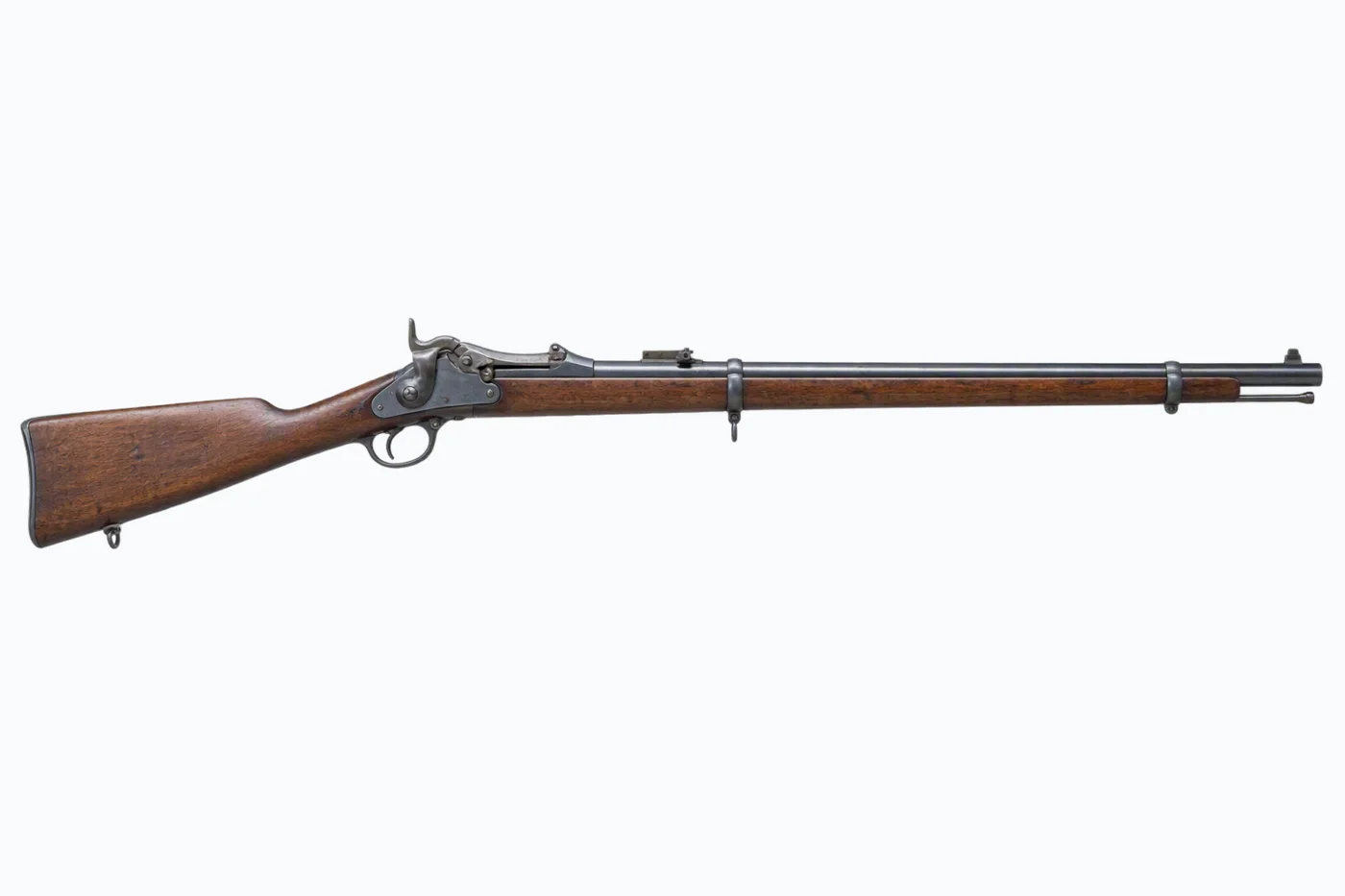
Wilson · Rifle
Wilson Trade Gun
Muzzleloader · .60 Caliber Ball · introduced 1750
Also known as Northwest Trade Gun, Northwest Gun, Indian Trade Gun
About the Wilson Trade Gun
The Wilson Trade Gun is a light smoothbore flintlock musket built by the Wilson family of London gunmakers, one of the most sought-after patterns of the Northwest Trade Gun supplied to the North American fur trade. Chambered around a roughly .60 caliber (20 gauge) smoothbore barrel that could load a round ball or shot, it was shorter, lighter, and handier than a military musket of the era, making it ideal for hunting and travel. It is instantly recognized by its cast brass serpent (dragon) sideplate, oversized 'mitten-friendly' trigger guard, and octagon-to-round barrel marked with the maker's tombstone-and-fox trade proofs prized by Native buyers.
The serpent sideplate became a mark of authenticity so trusted in the fur trade that native buyers judged a gun's quality by it, and rival makers were forced to reproduce the Wilson pattern faithfully because tribes would refuse guns that lacked the familiar brass dragon and oversized trigger bow.
Wilson Trade Gun specifications
General
- Type
- Rifle
- Action
- Muzzleloader
- Firing mechanism
- Flintlock
- Trigger
- Single stage
- Calibres
- .60 Caliber Ball
Dimensions
- Barrel length
- 1067 mm (42.0 in)
- Overall length
- 1473 mm (58.0 in)
- Weight (empty)
- 2.90 kg (6.39 lb)
Barrel
- Rifling
- None
Materials
- Barrel
- Steel
- Stock
- Wood
- Finish
- browned_steel
Performance
- Muzzle velocity (typical)
- 300 m/s (984 fps)
- Effective range
- 55 m
History
- Introduced
- 1750
- Discontinued
- 1860
- Production status
- Out of production
- Country of origin
- GB
- Designer
- Richard Wilson
Features
- Smoothbore barrel
- Muzzle loaded
- Octagon to round barrel
- Serpent sideplate
- Oversized trigger guard
- Brass furniture
- Ramrod
Safety
- Half cock notch
Richard Wilson helped establish the prototypical Northwest Trade Gun pattern, and later Wilsons including William Wilson supplied the Board of Ordnance, the East India Company, and the Hudson's Bay Company. Bore sizes generally ran from 16 to 28 gauge with about 24 gauge (~.58-.60 caliber) predominant, and barrels ranged from roughly 30 to 48 inches; the ~42 inch, ~58 inch overall figures here are representative. By the end of the War of 1812 the pattern was so dominant that American makers copied it because native buyers would accept no other model.