
Henry · Rifle
Nock Volley Gun
.50 Caliber Ball · introduced 1779
Also known as Seven-Barrel Volley Gun, Nock Gun
About the Nock Volley Gun
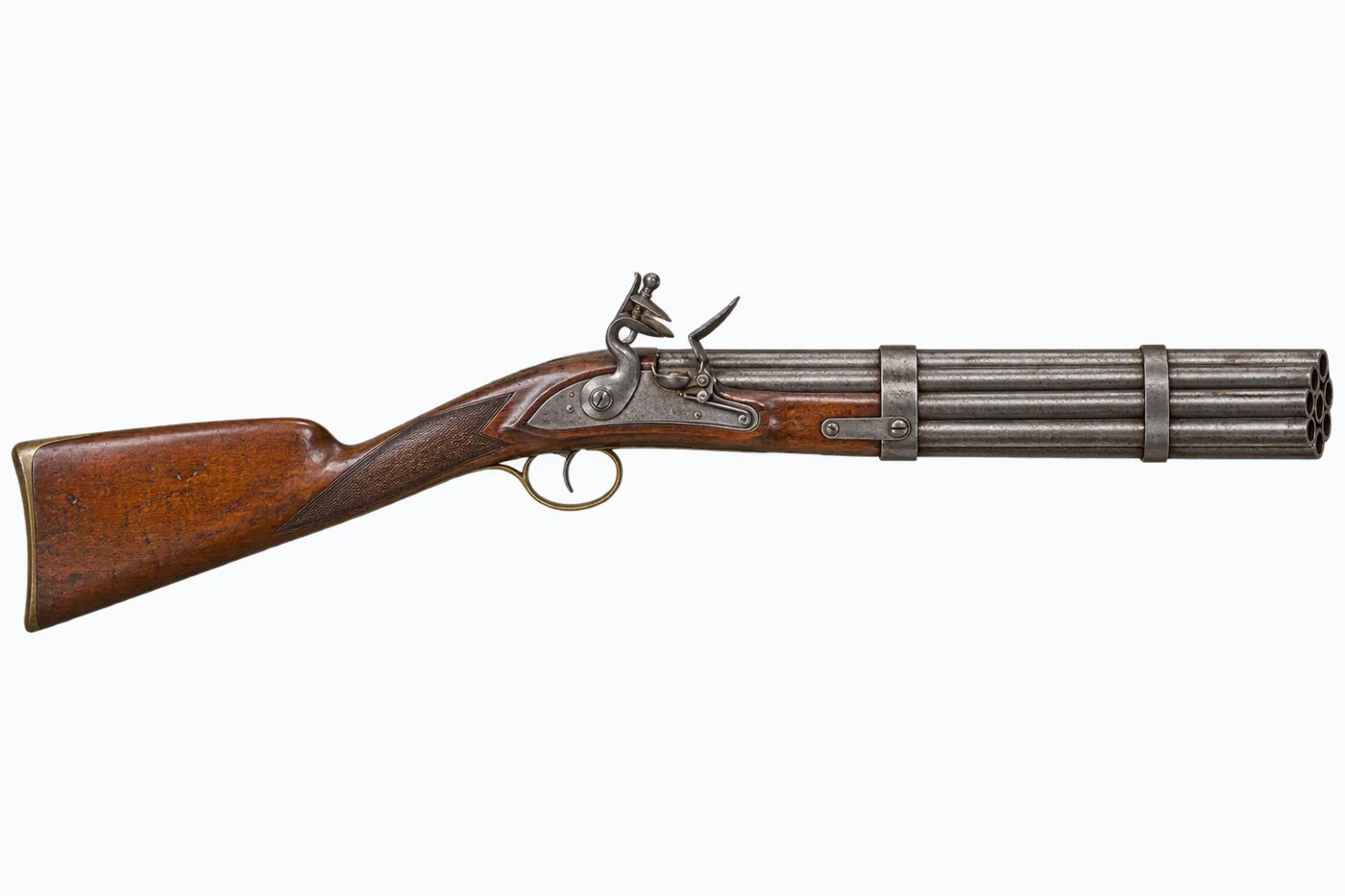
The Nock Volley Gun was a seven-barrel flintlock long arm designed by James Wilson in 1779 and manufactured by London gunmaker Henry Nock for the Royal Navy. Its seven brazed-together barrels of roughly .50 caliber all fired simultaneously from a single flintlock, the central barrel igniting the six surrounding ones through interconnecting vents, intended to sweep an enemy deck during boarding actions. Despite its fearsome volley, ferocious recoil and the risk of igniting a ship's own sails and rigging kept it from wide use, and it was withdrawn from service by 1804.
Designed to be fired down onto boarding parties from the 'fighting tops' of warships, it was rarely actually used at sea because discharging all seven barrels at once could ignite the ship's own rigging, and the brutal recoil could reportedly dislocate the firer's shoulder. It later became the signature weapon of Sergeant Harper in the Sharpe novels.
Nock Volley Gun specifications
General
- Type
- Rifle
- Firing mechanism
- Flintlock
- Trigger
- Single stage
- Calibres
- .50 Caliber Ball
- Magazine capacity
- 7 rounds
- Magazine
- Internal
Dimensions
- Barrel length
- 510 mm (20.1 in)
- Overall length
- 927 mm (36.5 in)
- Weight (empty)
- 5.44 kg (11.99 lb)
Barrel
- Rifling
- None
Materials
- Barrel
- Steel
- Receiver / frame
- Steel
- Stock
- Wood
History
- Introduced
- 1779
- Discontinued
- 1804
- Production status
- Out of production
- Country of origin
- GB
- Designer
- James Wilson
Features
- Seven barrel
- Muzzle loading
- Simultaneous volley
- Interconnected vents
Caliber varies by source (~.32 to ~.50 bore); Royal Museums Greenwich gives 0.5 in. Service powder charge was later reduced from 2.5 to 1.5 drams per barrel to tame the recoil. About 655 built between 1780 and 1788.
Similar models
Automatgevär m/42 (Ljungman)
Gas-operated (direct impingement) · 6.5x55mm Swedish
Air Arms FTP900
Single action · .177 Air (4.5mm)
Air Arms S410
Bolt action · .22 Air (5.5mm)
Anschütz 1727 F
Bolt action · .22 Long Rifle
Anschutz 1761 APR
Bolt action · .22 Long Rifle
Armaguerra Mod. 39 (OM-44)
Short recoil (semi-automatic) · 7.35x51mm Carcano