
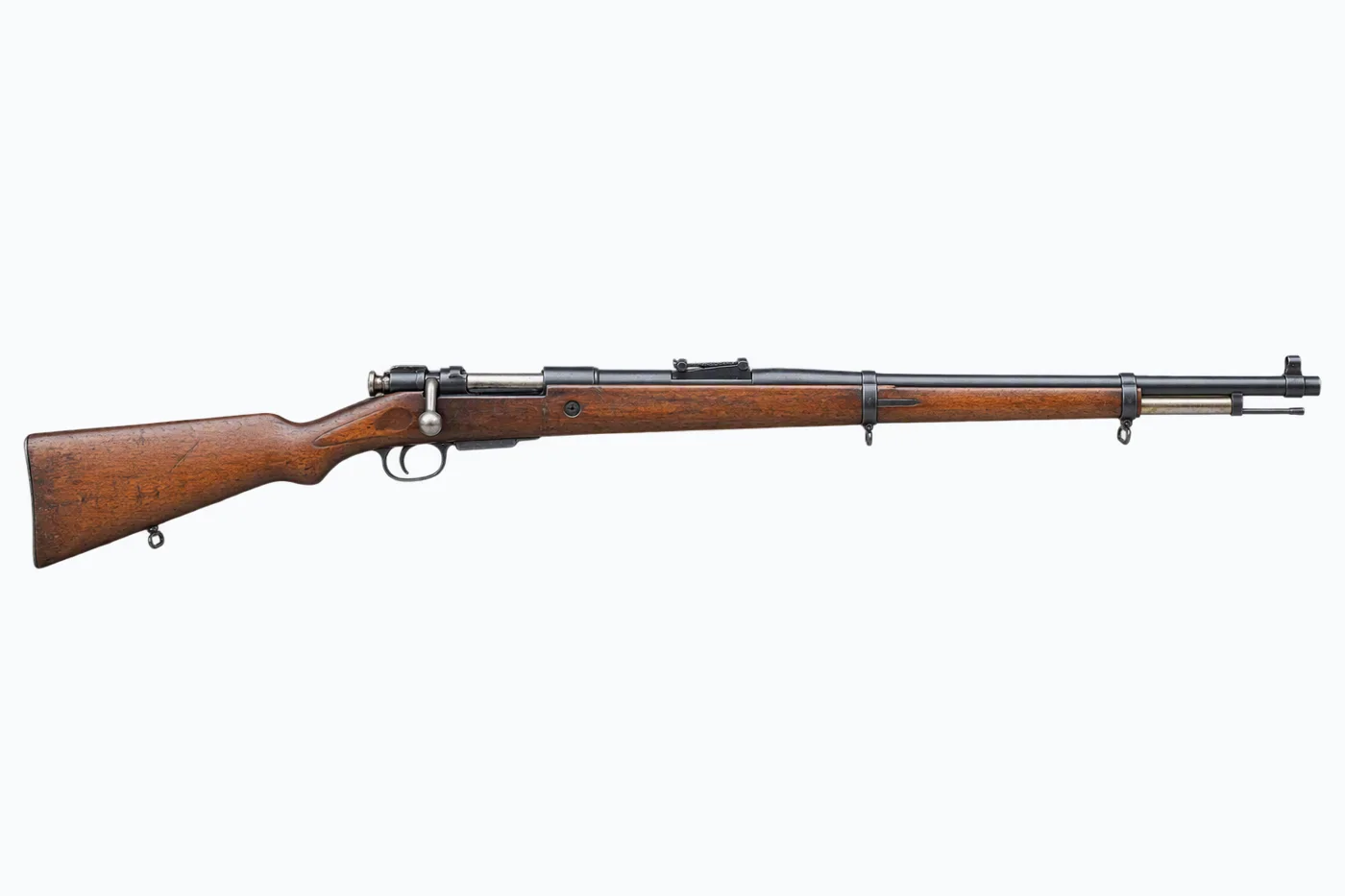
Österreichische · Rifle
Kropatschek M1886
Bolt action · 8x60mmR Portuguese · introduced 1886
Also known as Mauser-Kropatschek M1886, Espingarda m/1886, Portuguese Kropatschek
About the Kropatschek M1886
The Kropatschek M1886 is an Austrian-designed bolt-action service rifle chambered for the 8x60mmR Portuguese (8mm Guedes) cartridge, adopted by Portugal in 1886 as the Espingarda de Infantaria m/1886. Designed by Alfred von Kropatschek and built by Österreichische Waffenfabriks-Gesellschaft (OEWG) at Steyr in Austria, it married a turning-bolt action to a Kropatschek-pattern tubular magazine running through the forestock, holding eight rounds with a magazine cutoff that let the soldier hold the tube in reserve and load single cartridges. The same tube-magazine layout was shared with the German Gewehr 1871/84 and Japanese Murata Type 22, and it directly influenced the French Lebel Mle 1886. Although designed around a black-powder cartridge, the robust action proved strong enough to handle later smokeless loadings. Portugal kept the Kropatschek in front-line and then colonial service for decades, with examples seeing use through the First World War and surviving in colonial hands as late as the 1960s.
The Kropatschek's tubular magazine sat squarely on the threshold between the old black-powder world and the smokeless age: conceived for a black-powder cartridge, its action turned out tough enough to digest the new nitro powders that would soon make tube magazines obsolete. Portugal's adoption gave the small nation one of the more modern repeating rifles in Europe for a brief moment, and the design's lineage runs straight into the more famous French Lebel that followed it.
Kropatschek M1886 specifications
General
- Type
- Rifle
- Action
- Bolt action
- Firing mechanism
- Striker-fired
- Trigger
- Single stage
- Calibres
- 8x60mmR Portuguese
- Magazine capacity
- 8 rounds
- Magazine
- Tubular
Dimensions
- Barrel length
- 820 mm (32.3 in)
- Overall length
- 1322 mm (52.0 in)
- Weight (empty)
- 4.57 kg (10.08 lb)
Barrel
- Rifling
- Right hand
- Grooves
- 4
Materials
- Barrel
- Steel
- Receiver / frame
- Steel
- Stock
- Wood
- Finish
- blued
Performance
- Muzzle velocity (typical)
- 535 m/s (1755 fps)
- Muzzle energy (typical)
- 2203 J (1625 ft·lb)
- Effective range
- 500 m
History
- Introduced
- 1886
- Discontinued
- 1894
- Production status
- Out of production
- Country of origin
- AT
- Designer
- Alfred von Kropatschek
Features
- Tubular magazine in forestock
- Nickel plated steel magazine tube
- Magazine cutoff
- Ramp and leaf rear sight
- Blade front sight
- Full length wooden stock
- Side mounted cleaning rod
- Sling swivels
- Bayonet lug
- Straight bolt handle
Safety
- Magazine cutoff
- Half cock notch
The original black-powder 8x60mmR Guedes cartridge was later supplemented by the smokeless 8x56mmR Kropatschek loading, which used the same bullet in a shortened case. Roughly 49,000 infantry rifles, 4,800 short rifles and 4,000 carbines were produced by OEWG Steyr between 1885 and 1894. The improved M1886/89 pattern extended the rear sight graduations.
Kropatschek M1886 variants
Similar models
Steyr Mannlicher Classic
Bolt action · .30-06 Springfield
Carabina de Artilharia 8 mm m/1886/91
Bolt action · 8x60mmR Portuguese
Carabina de Cavalaria 8 mm m/1886
Bolt action · 8x60mmR Portuguese
Kropatschek Torpedo Boats Gewehr M1893
Bolt action · 8x50mmR Mannlicher
Kropatschek m/1886/89
Bolt action · 8x60mmR Portuguese
Steyr LG110
Single action · .177 Air (4.5mm)
Steyr Zephyr
Bolt action · .22 Long Rifle
Steyr Zephyr II
Bolt action · .22 Long Rifle