
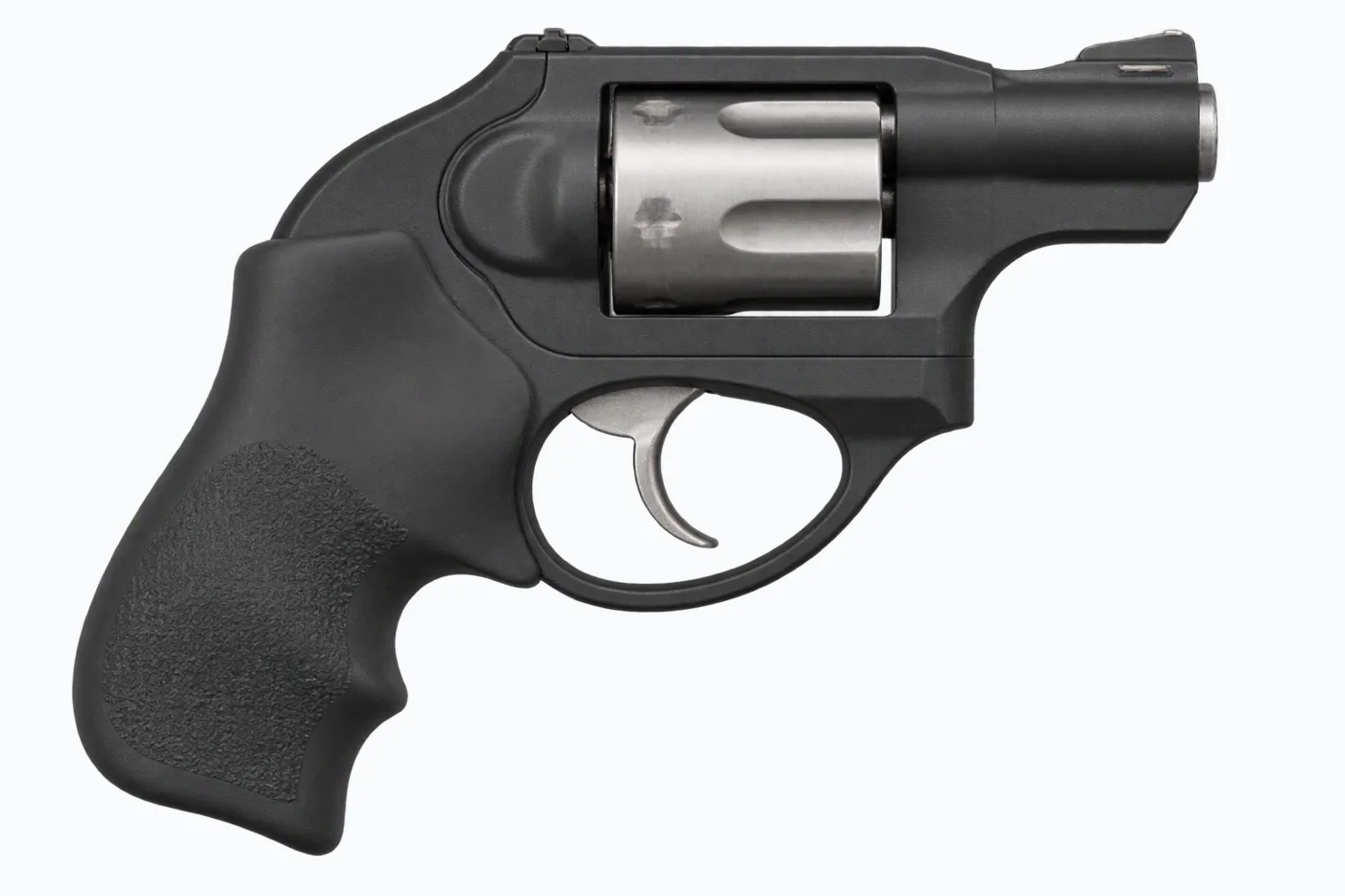
Ruger · Pistol
Ruger LCR
Double action · .38 Special +P · introduced 2009
Also known as Lightweight Compact Revolver
About the Ruger LCR
The Ruger LCR (Lightweight Compact Revolver) is a five-shot, double-action-only revolver chambered in .38 Special +P, introduced in 2009 as Ruger's entry into the lightweight concealed carry revolver market. The LCR features a revolutionary hybrid construction using three different materials: a polymer fire control housing (grip and trigger guard area), an aerospace-grade 7000-series monolithic aluminum frame, and a stainless steel cylinder. This tri-material construction results in a revolver weighing just 13.5 ounces (383g), making it one of the lightest production .38 Special revolvers available. The LCR's most acclaimed feature is its patented friction-reducing cam fire control system, which produces a remarkably smooth, non-stacking double-action trigger pull of approximately 11 pounds (49 N) - widely considered the best factory trigger in any small-frame revolver. The enclosed/shrouded hammer design eliminates external snag points, making the revolver ideal for drawing from pockets or concealment holsters. The front sight is a replaceable, pinned ramp design, while the rear sight is an integral U-notch machined into the frame. Standard grips are the Hogue Tamer Monogrip, a cushioned rubber grip that helps mitigate the sharp recoil inherent in firing +P ammunition from such a lightweight platform. The 1.87-inch barrel features right-hand rifling with a 1:16-inch twist rate and 6 grooves.
The LCR's polymer fire control housing was initially met with skepticism by revolver traditionalists who questioned whether plastic had any place in a revolver. Ruger silenced critics with torture tests showing the LCR could withstand thousands of rounds of +P ammunition without issue. The friction-reducing cam trigger quickly became the revolver's most praised feature, with many reviewers calling it the best double-action trigger in any snub-nose revolver, period. The LCR helped spark a renaissance in lightweight concealed carry revolvers and has become the standard by which other pocket revolvers are judged.
Ruger LCR specifications
General
- Type
- Pistol
- Action
- Double action
- Firing mechanism
- Double action only
- Trigger
- Double action
- Trigger pull
- 5.0 kg (11.0 lb)
- Calibres
- .38 Special +P
- Magazine capacity
- 5 rounds
Dimensions
- Barrel length
- 48 mm (1.9 in)
- Overall length
- 165 mm (6.5 in)
- Height
- 114 mm (4.5 in)
- Width
- 33 mm (1.3 in)
- Weight (empty)
- 0.38 kg (0.84 lb)
- Weight (loaded)
- 0.42 kg (0.94 lb)
Barrel
- Rifling twist
- 1:16 in (406 mm)
- Rifling
- Right hand
- Grooves
- 6
Materials
- Barrel
- Stainless steel
- Receiver / frame
- Aluminum alloy
- Finish
- matte_black
Performance
- Muzzle velocity (typical)
- 274 m/s (899 fps)
- Muzzle energy (typical)
- 316 J (233 ft·lb)
- Effective range
- 15 m
History
- Introduced
- 2009
- Production status
- In production
- Country of origin
- US
Features
- Friction reducing cam trigger
- Polymer fire control housing
- Aerospace aluminum frame
- Stainless steel cylinder
- Replaceable pinned ramp front sight
- U notch integral rear sight
- Hogue tamer monogrip
- Five shot cylinder
- Shrouded hammer
- Snag free profile
Safety
- Transfer bar
- Enclosed hammer
The Ruger LCR represented a significant departure from traditional revolver construction when it debuted in 2009. The use of a polymer fire control housing - which contains the trigger mechanism, hammer, and mainspring - was unprecedented in revolver design and drew initial skepticism from revolver purists. However, the design has proven extremely durable and reliable over more than a decade of production. The friction-reducing cam trigger operates differently from traditional double-action mechanisms: instead of the hammer spring's resistance building progressively as the trigger is pulled, the cam system smooths out the trigger pull force curve, resulting in a pull that feels lighter and more consistent than competing designs despite similar peak forces. This innovation was developed by Ruger engineer Mark Gurney. The LCR line has expanded from the original .38 Special +P model to include .357 Magnum (17 oz with steel frame), 9mm Luger (with moon clips), .327 Federal Magnum (6-shot), .22 LR (8-shot), and .22 WMR (6-shot) variants. The .357 Magnum and 9mm versions use an all-steel frame to handle the increased pressures, bringing weight up to 17.1 ounces. The LCRx variant, introduced in 2013, features an exposed hammer allowing single-action cocking. With a 130-grain .38 Special +P load, the 1.87-inch barrel typically achieves approximately 900 fps (274 m/s) with about 316 joules of muzzle energy. The loaded weight estimate includes five .38 Special +P cartridges at approximately 8.4g each. Despite its light weight, the LCR has proven remarkably reliable and has become one of the best-selling concealed carry revolvers in the United States.
Similar models
Ruger 22 Charger
Short recoil (semi-automatic) · .22 Long Rifle
Ruger 22/45 Lite
Short recoil (semi-automatic) · .22 Long Rifle
Ruger 22/45 Lite Mark IV
Short recoil (semi-automatic) · .22 Long Rifle
Ruger 22/45 Mark II
Short recoil (semi-automatic) · .22 Long Rifle
Ruger 22/45 Mark III Bull Barrel
Short recoil (semi-automatic) · .22 Long Rifle
Ruger 22/45 Mark III Hunter
Short recoil (semi-automatic) · .22 Long Rifle
Ruger 22/45 Mark IV
Short recoil (semi-automatic) · .22 Long Rifle
Ruger 22/45 Tactical Mark IV
Short recoil (semi-automatic) · .22 Long Rifle