
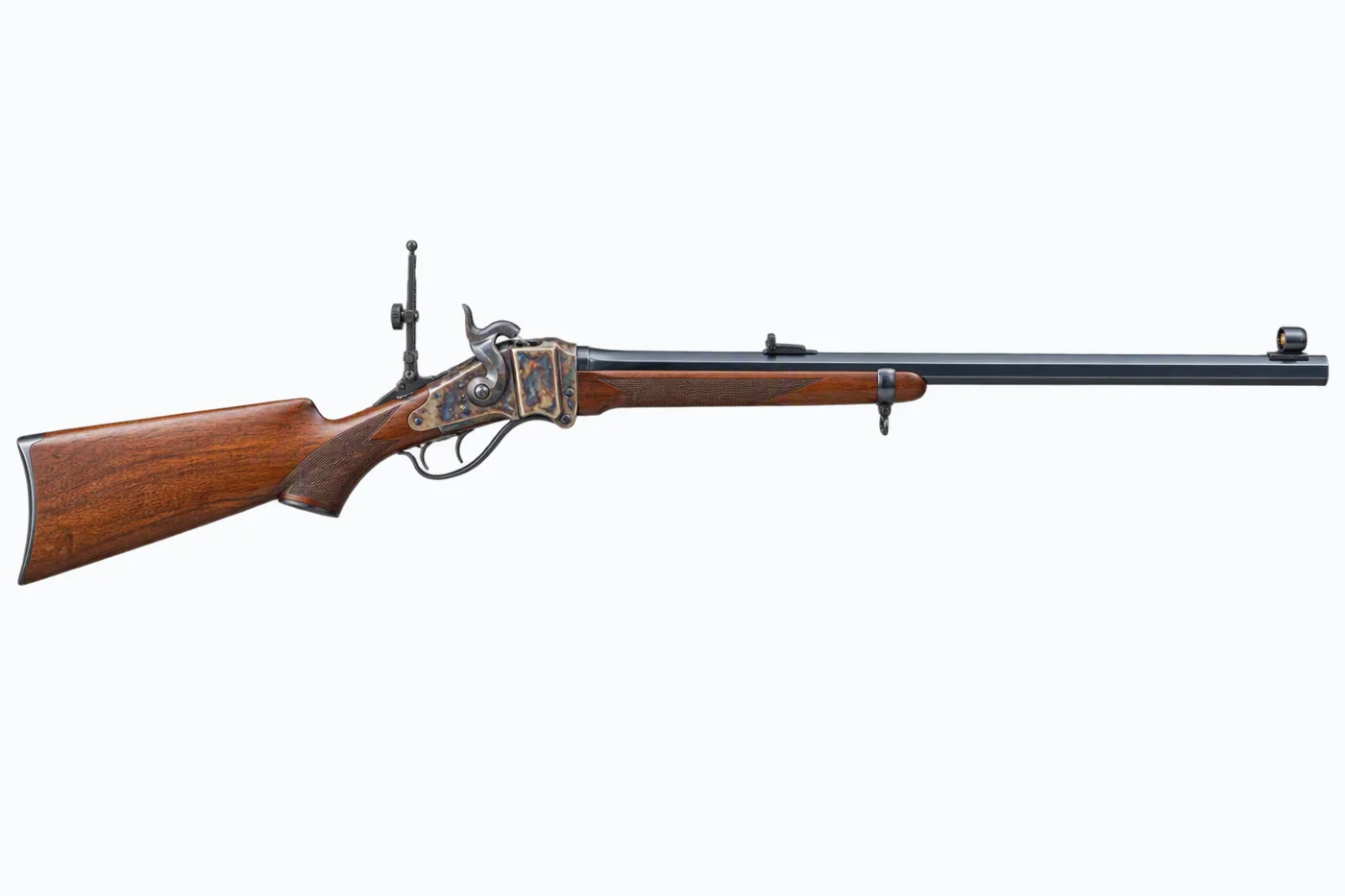
Sharps · Rifle
Sharps Model 1874
Bolt action · .50-90 Sharps · introduced 1871
Also known as Old Reliable, Sharps Old Reliable, Big Fifty
About the Sharps Model 1874
The Sharps Model 1874 is a single-shot, breech-loading rifle built around a falling-block action operated by a lever that also functions as the trigger guard. Introduced in 1871 by the Sharps Rifle Manufacturing Company and officially branded 'Old Reliable' in April 1876, it became the definitive American buffalo rifle and a dominant long-range target rifle of its era. Highly customizable, customers could order virtually any barrel length (typically 26-34 inches), weight (7-25 pounds), and shape (round, octagon, or half-round/half-octagon), along with a wide array of chamberings from .40 to .50 caliber, double-set triggers, Vernier tang sights, globe front sights, and schnabel forends. Its massive black-powder cartridges delivered unparalleled long-range accuracy and terminal energy, making it the preferred tool of professional bison hunters on the Great Plains and the rifle of choice at the famous 1874 Creedmoor long-range matches.
On June 29, 1874, buffalo hunter Billy Dixon used a borrowed .50-caliber Sharps Model 1874 to knock a Comanche warrior from his horse at an Army-surveyed distance of 1,538 yards (1,406 m) during the Second Battle of Adobe Walls, breaking the spirit of the attacking coalition and becoming one of the most legendary shots in firearms history. In the hands of professional hide hunters such as Bill Tilghman - who allegedly killed over 7,500 buffalo with his Sharps - and J. Wright Mooar, the Model 1874 was the primary instrument of the near-extinction of the American bison, whose population collapsed from tens of millions to fewer than 1,000 animals by 1889.
Sharps Model 1874 specifications
General
- Type
- Rifle
- Action
- Bolt action
- Firing mechanism
- Hammer-fired
- Trigger
- Single stage
- Calibres
- .50-90 Sharps, .40-90 Sharps, .45-110 Sharps, .45-120 Sharps, .45-70 Government, .50-70 Government
- Magazine capacity
- 1 rounds
- Magazine
- Internal
Dimensions
- Barrel length
- 762 mm (30.0 in)
- Overall length
- 1219 mm (48.0 in)
- Weight (empty)
- 5.44 kg (12.00 lb)
- Weight (loaded)
- 5.50 kg (12.13 lb)
Barrel
- Rifling
- Right hand
- Grooves
- 6
Materials
- Barrel
- Steel
- Receiver / frame
- Steel
- Stock
- American walnut
- Finish
- blued barrel with case-hardened receiver
Performance
- Muzzle velocity (typical)
- 411 m/s (1348 fps)
- Muzzle energy (typical)
- 2466 J (1819 ft·lb)
- Effective range
- 500 m
History
- Introduced
- 1871
- Discontinued
- 1881
- Production status
- Discontinued
- Country of origin
- US
- Designer
- Christian Sharps (original 1848 Sharps action); Richard S. Lawrence and Hugo Borchardt (later refinements)
Available calibres
Features
- Falling block action
- Breech loading
- Side hammer
- External hammer
- Optional double set triggers
- Octagon barrel option
- Vernier tang sight option
- Globe front sight option
- Buckhorn rear sight
- Crescent buttplate
- Schnabel forend option
Safety
- Half cock hammer
The template schema lacks an explicit 'falling_block' enum value, so action_type is recorded as 'bolt_action' as the nearest manually-operated repeater; functionally the Model 1874 uses a true falling-block breech-loading action operated by the underlever. Specifications listed represent a typical heavy-barrel sporting/buffalo configuration; actual weights ranged from ~3.2 kg to ~11.3 kg (7-25 lb) depending on barrel profile and caliber. Production ran from 1871 until manufacturing ceased in October 1880, with the company dissolving in 1881.
Similar models
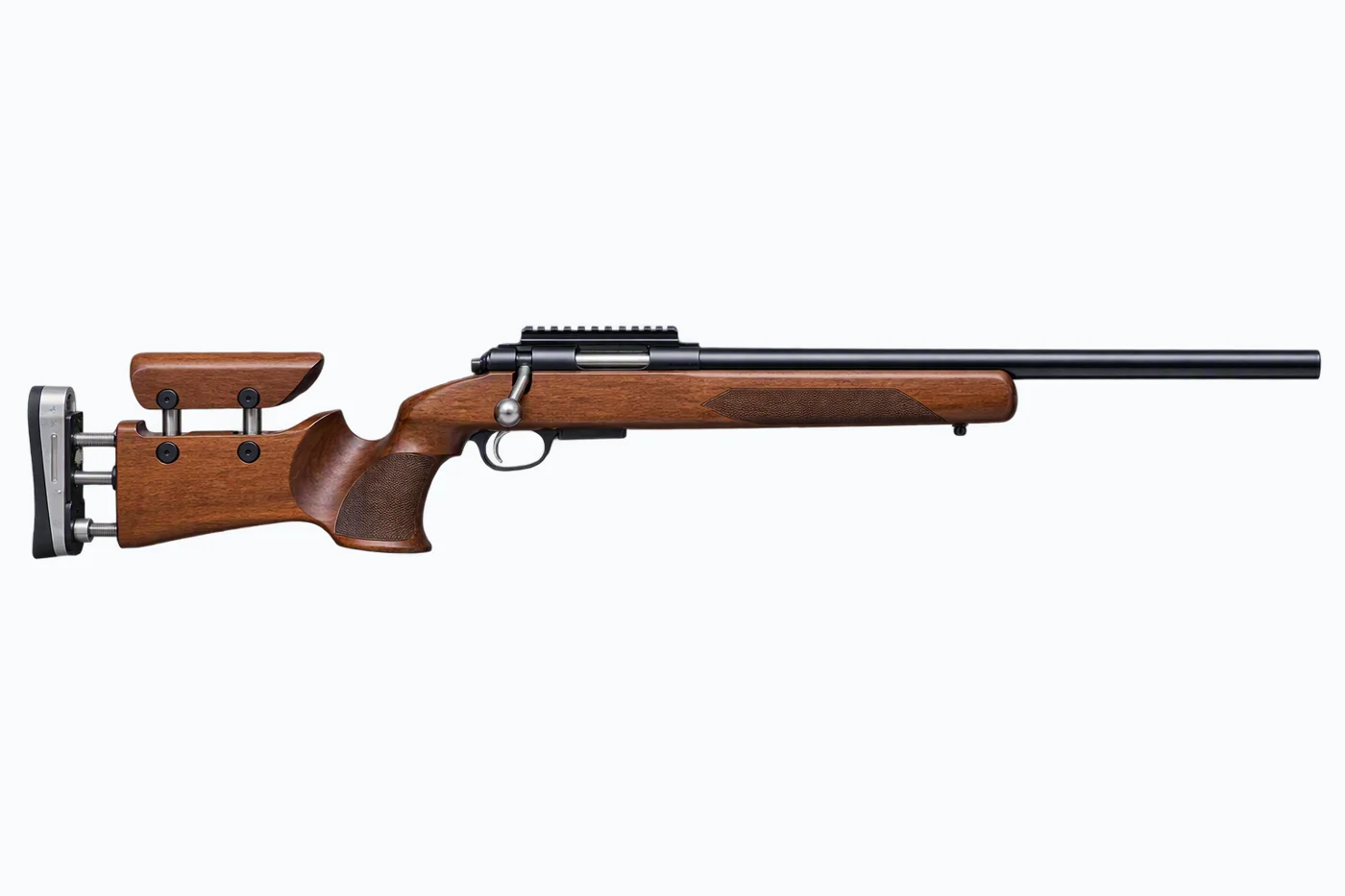
Anschütz 1903
Bolt action · .22 Long Rifle
Anschutz 1907
Bolt action · .22 Long Rifle
Ballard No. 1½ Hunter's Rifle
Falling block · .45-70 Government
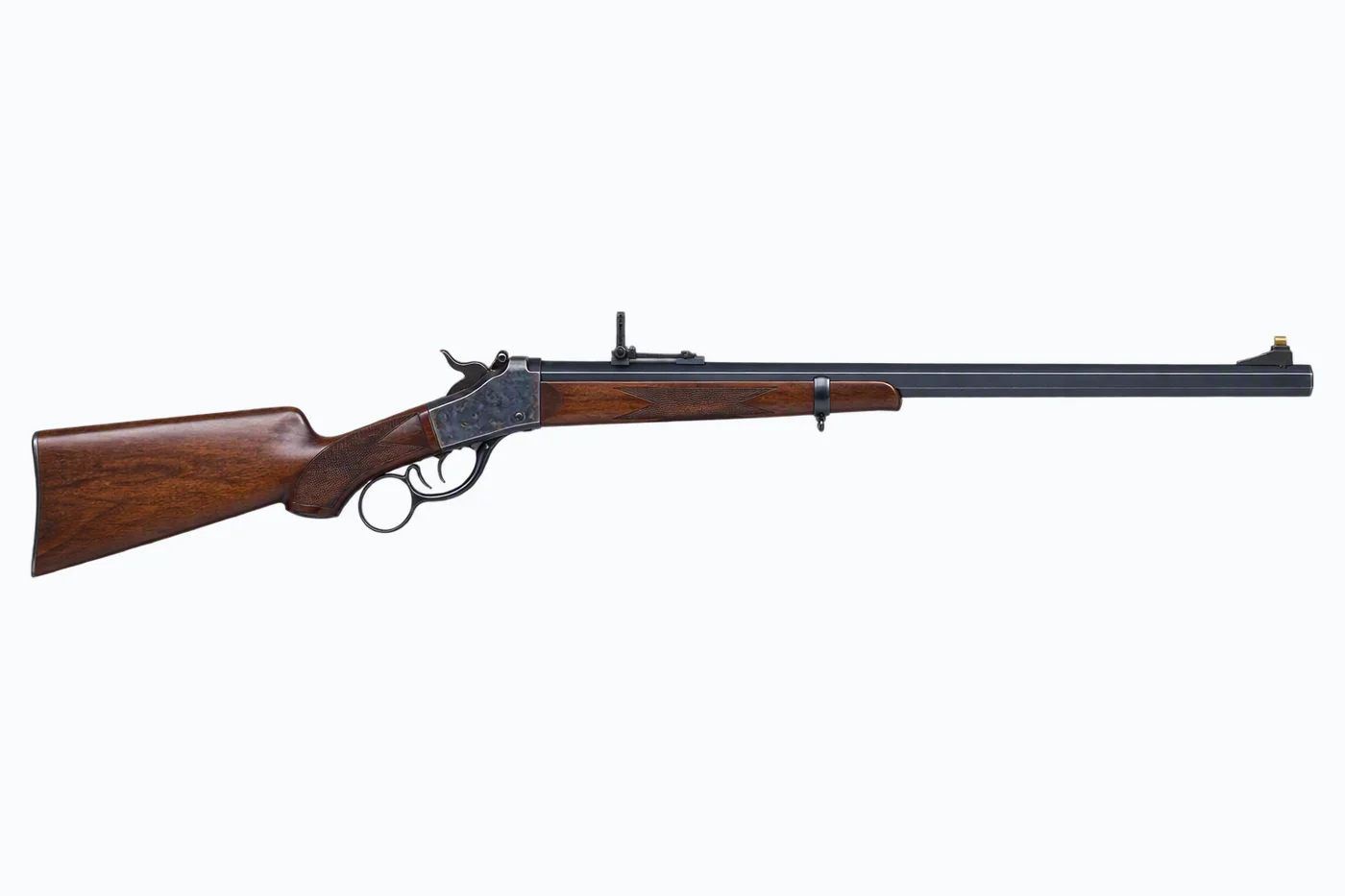
Ballard No. 5 Pacific
Falling block · .45-70 Government
Ballard No. 5 Pacific
Falling block · .45-70 Government